
David Wojick commented on Ed’s paper on Climate Depot
No doubt the IPCC is wrong but there are skeptical climate scientists that do not accept Ed Berry’s argument, including me.
In my case it is not the calculations, but the conclusion that is the problem. Given the huge natural CO2 flux it is indeed true that the remaining mass of our emissions is much less than the total mass of the CO2 increase.
But it simply does not follow that this small fraction is the fraction of our causality. Causality is not that simple.
My view is that we have no idea what is causing the CO2 increase, because we have no information of the specific behavior of the myriad natural sources and sinks, on land and in the oceans, that in combination create the huge flux. We also do not know what happens to the molecules while they are in the air.
For example, there is evidence that most of our emitted molecules are absorbed locally and never make it into the general atmospheric reservoir. Or maybe they do. Some scientists argue that the warming ocean is causing the increase.
We might be causing all of the increase or none of it, or something in between, such as along the lines of Ed Berry’s argument.
There are plausible arguments for many possibilities, so I think we simply do not know.
These myriad natural emissions and absorptions are each collectively 20 times our emissions and so big that about 25% of the atmospheric CO2 is exchanged every year.
None are measured. This is the huge CO2 flux and since nothing is measured or tracked we have no idea why the concentration is increasing.
Because about 25% of the atmospheric CO2 is removed and replaced every year the half life residence time of our emitted molecules is less than 3 years. Almost all is gone in 6 to 8 years. There is a big literature on this.
The replacement math gets hairy.
The common saying that only about 50% gets removed is confusing the ratio of the increase to our emissions with the flux. The increase is presently about 50% of our emissions but almost 100% of our molecules are gone in 8 years or less.
That the increase is a buildup of our emissions is a useful (to the alarmists) falsehood. The reality is nothing like that.
I have no quarrel with his calculations, but they do not prove his conclusion.
I can describe a case where our emitted molecules cause the entire increase, but they are then replaced by natural molecules in the flux, giving his numbers.
I am not saying this is what happens, just that we do not know that it does not happen, so his conclusion does not follow from his calculations.
The point is one of logic, which happens to be my field, especially the logic of scientific reasoning.
Ed Berry replied to the above comments as follows:
Dear David,
Thank you for your comment. However, you have missed the main logic point of my paper.
My paper begins with the source of climate alarmism, namely the CORE ASSUMPTION that human CO2 causes all (or most) of the observed increase in atmospheric CO2. The official statement of this core assumption is in the IPCC reports that my paper references.
My paper uses IPCC’s data for its natural carbon cycle to prove this assumption is wrong. That is a major accomplishment because this assumption is the basis of all climate alarmism, laws, regulations, treaties, and education. My paper makes all those laws, etc., scientifically invalid.
The only scientific way to prove my paper’s conclusions are wrong is to show there is a fundamental error in my paper, which no one has done.
You divert the discussion of my paper into a discussion of whether IPCC’s natural carbon cycle is valid. That is outside the scope of my paper.
However, we can discuss that subject. IPCC’s natural carbon cycle is one of the good IPCC products. It is the most accurate data we have for the natural carbon cycle. Yes, it simplifies the natural carbon cycle by putting it into four key reservoirs but that is how science works, and the IPCC gives error bounds on its data.
You have no data. You merely question the data, which we all do. Questioning the data does not invalidate my paper or its conclusions.
Until you can provide better data for the natural carbon cycle, your criticism of my paper is invalid. My paper begins with the best data we have, and it shows that this data proves IPCC’s core assumption is wrong.
A logical point
The logical point that you miss is that it is impossible to prove a theory (or assumption) is true (as climate alarmists try to do) but only one contradiction with data proves a theory is false.
My paper supplies that contradiction. That is an important scientific conclusion. It means there is no longer any scientific basis to support IPCC’s core assumption.
Negating a theory or a widely held belief is one of most important things we can do in science. Negating a theory focuses scientific attention on what is left over after that negation.
Scientific theories must begin and end with data.
The physics carbon cycle in my paper is built on only one assumption: Outflow equals Level divided by e-Time:
Outflow = Level / e-Time (2)
IPCC’s natural carbon cycle makes the same assumption. E-time is the same thing as IPCC’s “Turnover time.” Pharmacological models use this assumption. Dalton’s Law of Partial Pressures supports this assumption.
The IPCC says annual human CO2 emissions are about 5% of the total of human and natural CO2 emissions.
Human CO2 and natural CO2 have the same e-times because their molecules are identical. Therefore, using (2) we get,
Te = Lh / Ih = Ln / I n
Lh / Ln = Ih / In
where L is level, I is inflow, and the subscripts h and n stand for human and natural, respectively.
Therefore, simple first-order calculations show the ratio of the levels equals the ratio of the inflows at equilibrium. So, to the first approximation, human CO2 about 5% of atmospheric CO2. Compare that to the 30% required to satisfy the incorrect core assumption.
The physics model in my paper does the second order calculations. It uses IPCC’s natural carbon cycle data and measured annual human CO2 emissions to calculate the true effect of human CO2 emissions. In includes human CO2 that recycles back into the atmosphere and the transfer of human carbon from the slow carbon cycle to the fast carbon cycle.
Data for delta 14C and 12CO2 since 1960 show the e-time of 14CO2 in the atmosphere is 10 years (Harde and Salby (2021) and Berry (2021)). This limits the e-time of 12CO2 to 10 years or much less than 10 years because 14C, being heavier, acts more slowly than 12C.
The IPCC states the e-time for 12CO2 is “about 4 years” and IPCC’s natural carbon cycle data show, more accurately, that the 12CO2 e-time is 3.5 years.
The physics model uses IPCC’s 3.5-year e-time to calculate that human-caused CO2 added about 33 ppm to the CO2 level as of 2020. That makes human CO2 8% of the total. Since this is nowhere near the 30% required by the core assumption requires, the core assumption is wrong.
This means human CO2 caused 25% and nature 75% of the increase in atmospheric CO2 above 280 ppm, as of 2020.
You agree with IPCC’s 4-year e-time and that human CO2 emissions are about 5% of natural CO2 emissions, and that the calculations in my paper are correct. Therefore, you have nowhere to go other than to agree with my paper’s conclusions.
Anyone who wants to promote IPCC’s core assumption must find new data that overturns IPCC’s natural carbon cycle data to support their argument. No one has done that, and no one is likely to do that.
And IF such new data were found, that does not contradict my paper because my physics carbon cycle model can quickly use the new data to make a new prediction.
My physics carbon cycle model is a significant contribution to climate science. The physics model shows the proper way to calculate the “replacement math” that you believe is “hairy.”
What is the “source” of the natural CO2 predicted by my paper?
As to the source of the CO2 increase in the natural 12CO2 level, my paper references a preprint by Skrabel and a preprint by Quirk. Both use carbon isotope data to conclude the CO2 increase came mostly from the oceans and not from human emissions.
One figure contains the key information.
Finally, my paper’s Figure 18 (in Section 6.1) shows how δ14C – after being pumped up to 650 in 1965 by the bomb tests – has almost returned to its original level of zero with a constant e-time of 16.5 years.
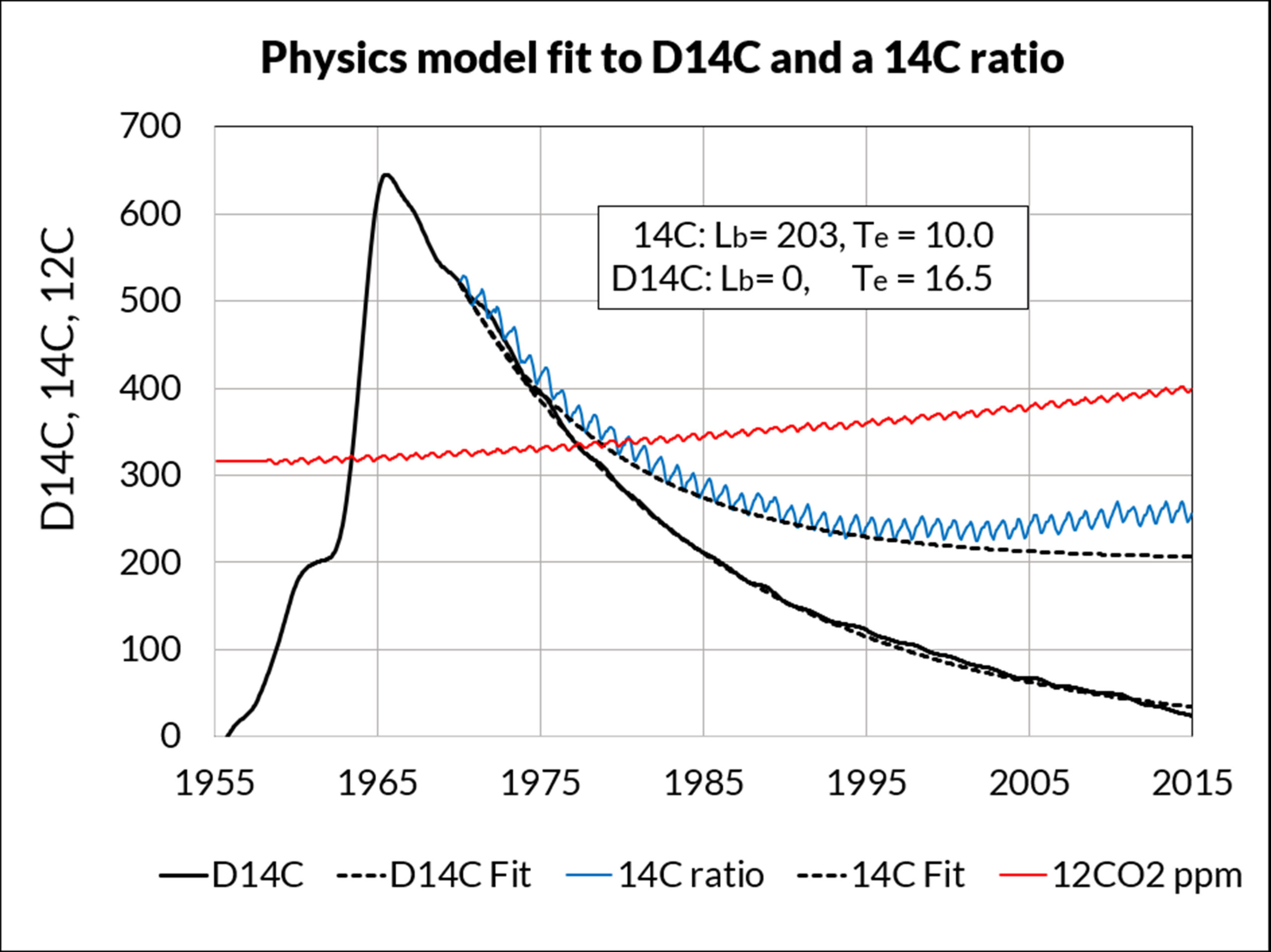
Meanwhile, the 12CO2 level (red in Figure 18) has increased since 1960 without affecting the steady return of δ14C to zero. This return is proof, all by itself, that nature is the dominant source of the increase. Why? Because the return of δ14C to zero shows that the source of the CO2 increase is natural.
Think about it. δ14C is a function of the ratio of 14C to 12C. It is used for carbon dating because before 1950 it was very constant at zero even as the level of 12CO2 in the atmosphere changed. Why constant? Because natural CO2 emissions have a δ14C equal to zero.
A δ14C of zero is a fingerprint of natural CO2 that has held long enough to allow carbon dating. Human CO2 has a δ14C of -1000, meaning it has no 14C. If human CO2 dominated the CO2 increase, it would have lowered the equilibrium level of δ14C. But today’s δ14C shows no effect of human CO2 emissions.
Therefore, natural CO2 has dominated the increase in atmospheric CO2 since 1750. For the scientific details please read my paper.
In conclusion, the only scientific way to argue that human CO2 dominates the increase is to prove there is a major error in my paper, or to make a major overhaul of IPCC’s data for the natural carbon cycle. All other arguments are irrelevant.
Thank you again for your comment