
by Dr. Ed Berry
Why climate truth is important to our lives, our economy, and our freedom.
Belief in the climate fraud is an act of self-destruction of the individual and a nation.
The climate myth costs America over $4 trillion per year. Climate truth could eliminate income tax, the annual deficit, and many other needless expenses. It would also improve education and significantly raise the national IQ.
USA agencies waste money, time, and talent trying to decarbonize the free world, to capture carbon, which is plant food, to promote irrational green energy and net zero, and to indoctrinate its people to believe the climate myth.
USA regulations force businesses to support green energy. These deficits increase inflation and cause economic decisions to depend on mythical science. USA stopped giving research grants and contracts for true climate physics research in 1992 after President GHW Bush signed the UN IPCC Earth Charter.
USA continues to indoctrinate students to believe the climate myth, which lowers their IQs and their ability to contribute to our economy and national defense. This climate myth indoctrination was the basis for the success of the COVID myth.
The claim that our CO2 changes the climate is based on these three invalid assumptions:
- Human CO2 causes all of the CO2 increase above 280 ppm.
- More CO2 increases the global temperature.
- Higher global temperatures cause harmful effects.
This website demonstrates that the three assumptions above are wrong.
By contrast, the CO2 Coalition continues to claim that Assumptions (1) and (2) are true. The CO2 Coalition censors the science on this website, is not a leader in climate truth, and is a threat to President Trump’s climate policies.
The CO2 Coalition differs from the alarmists only in Assumption (3), where they claim (correctly) that a warmer temperature is more beneficial to humanity than a cooler temperature.
Discussion of Assumption (1)
The following Delta 14C data prove that Assumption (1) is false. Delta 14C data show that human CO2 is less than about 3% of the CO2 in the atmosphere. Delta 14C is a measure of the ratio of 14C to 12C in the atmosphere.
The blue curved line that fits the blue dots shows the Delta 14C data. Following the bomb tests of the 1960’s, Delta 14C gradually returned to its original level of near zero.
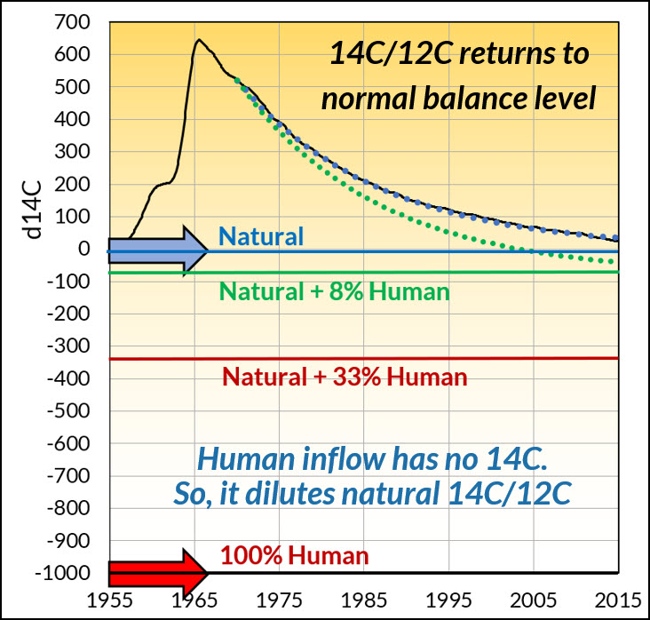
If human CO2 were 33% of the CO2 in the atmosphere, as climate alarmists and the CO2 Coalition claim, then Delta 14C would have returned to the red “Natural + 33% Human” line. Clearly, it did not. It is not even approaching the green “Natural + 8% Human” line.
We discuss Delta 14C in more detail in other posts.
The alarmists and the CO2 Coalition claim incorrectly that human CO2 flows out of the atmosphere more slowly than natural CO2. But that is impossible.
The climate equivalence principle says that human and natural CO2 molecules and carbon atoms are identical. Therefore, they flow out of the atmosphere at equal rates.
Alarmists argue that Assumption (1) is true because “the CO2 increase is about half of human emissions; therefore, human emissions cause all the increase.” That is not a physics argument. It is simply a repeat of Assumption (1).
Data show that natural CO2 emissions account for about 97% of all CO2 emissions, and human CO2 emissions account for about 3% of the total. Therefore, a 3% increase in natural CO2 emissions would have about the same effect on the CO2 level as all human emissions.
Discussion of Assumption (3)
The Berkeley study, among others, shows there is no correlation of global temperature or CO2 level with the alarmists’ claimed bad stuff in Assumption (3).
The IPCC and the Held v Montana plaintiffs argued that “because Assumption (3) is true, Assumptions (1) and (2) are true. This is illogical because events cannot prove their cause.
Alarmists argue that their “consensus” proves they are right. But Aristotle proved 2400 years ago that consensus is irrelevant in science. Votes do not decide science.
The climate myth reverses the scientific method. What the IPCC and the alarmists think is proof is really proof that their claim is false.
The IPCC claims”extensive scientific evidence” proves all three assumptions are true. However, the scientific method says it is impossible to prove an assumption is true. But one false prediction proves an assumption is false.
Aristotle described the scientific method 2400 years ago. Einstein said, “Many experiments may prove me right, but it takes only one to prove me wrong.”
Montana Republican leaders who censor Dr. Ed and his team of scientists endanger our lives, economy, and freedom. They deliberately lost Held v. Montana and forcefully prevented Dr. Berry and his science team from defeating it.
Dr. Berry,
I wish you’d start a yearly Climate Truth summit in Montana and have guest speakers and technical sessions. I’d come to that.
I challenged Grok on the cause of CO2 atmospheric increase bringing Berry’s study and Berry vs Andrews debate…here it is : https://x.com/i/grok?conversation=1926280716045758739
Thank you Dr Berry, on behalf of my grandchildren.
May God continue to bless you 🙏
Max,
Even though I didn’t have a twitter/x account, I couldn’t resist creating one to see what Grok would say. To my question “What is the cause of the atmospheric CO2 rise over the last century”, Grok concluded
“Conclusion
The dominant cause of the CO2 increase is human activity, particularly fossil fuel burning, as evidenced by d14C dilution, emission records, and carbon budgets. Berry’s argument for natural dominance, while engaging with d14C data, is an outlier, as it conflicts with observed sink behavior and isotopic evidence. Natural sources like ocean outgassing play a role in the carbon cycle but are not the primary driver of the century-long rise.”
This is an amusing exercise, but not particularly useful. I know that skeptics mistrust authority, and presumably that includes, or should include, AI. Therefore I never appeal to authority in my arguments, just to common sense. What does your common sense tell you about the cause of CO2 rise, given that human emissions are about 2x the rate of CO2 rise. Doesn’t that tell you that natural processes are on balance removing some of carbon from the atmosphere that we put there, not adding it? Doesn’t the CO2 added to the oceans explain the lowering of their ph, the observed “ocean acidification”? Doesn’t the observed increase in biomass tell you that land reservoirs must be gaining carbon from somewhere, not supplying it to the atmosphere?
Dear David,
Apparently, you do not understand that AI models without proper training produce “garbage in, garbage out.” They reflect the stupidity of their instructor.
Your next argument, which you claim is “common sense,” also fails logic because it rests on assuming Assumption (1) is true, which is circular reasoning.
You are correct that this error is “common” because too many humans like you follow your circular reasoning.
Ed,
I made the H(1) argument to Koonen when he published “Unsettled”. Never received a reply. Perhaps the authors will reply this time.
I wrote to President Trump and sent President Donald J Trump your website link to help you make argue your case
President Donald J Trump to hear Mr Ed Berry on man made Co2 is not cause of riase in Co2
In defense of law suit on President Donald J Trump E.O.
edberry.com
https://edberry.com/
I heard you on Bill Meyer show kmed.com
Dr, Berry,
You said “Carbon-14 data show human CO2 is less than 2% of atmospheric CO2.”. Could you provide me with a citation on that? I have a person claiming that humans caused a third of the CO2.
Thank you
Ray
Ray July 30, 2025 at 4:16 pm
Hi Ray,
My citation is Berry (2023). You can read it here: https://edberry.com/berry-vs-andrews/
I’m referring to a previous comment by David Andrews. If I understand correctly, the so-called “mass balance” argument (repeated like a parrot by the indoctrinated AI Grok) goes something like this: humans emit 38 billion tons (Btons) of CO₂ annually, while the observed increase in atmospheric CO₂ is only 19 Btons per year. Since 19 is less than 38, the conclusion drawn is that Nature must be a net emitter and therefore cannot be contributing to the rise in atmospheric CO₂.
This reasoning, however, is fundamentally flawed.
When we examine both natural and human carbon flows, we recognize that emissions in a given year are also partially reabsorbed by natural systems. The carbon cycle—whether considering human or natural contributions—is defined by a continuous process of emission followed by absorption. The net change in atmospheric CO₂ concentration depends not only on gross emissions, but also critically on how much is reabsorbed.
With this in mind, the correct “mass balance” equation should be expressed as:
DC = HE + NE – NA
Where:
• DC = Annual change in atmospheric CO₂
• HE = Human emissions
• NE = Natural emissions
• NA = Total absorption by nature
Since nature absorbs portions of both human and natural emissions, we can further detail NA as follows:
NA = HE* fh + NE*fn
Where:
• fh = Fraction of human emissions absorbed annually
• fn = Fraction of natural emissions absorbed annually
Combining these equations allows us to isolate NE:
NE = [DC – HE*(1 – fh)]/(1-fn)
The flawed mass balance argument assumes fh = 0 and fn = 0, which leads to NE = DC – HE. Substituting the proposed numbers, this implies:
NE = 19 – 38 = -19
This would mean nature actually reduces atmospheric CO₂— hence the conclusion that it cannot contribute to the increase.
But this scenario ignores reality: both fh and fn are undeniably greater than zero. When this is correctly accounted for, NE can easily exceed zero and, in fact, become dominant in the balance.
I refer to this oversimplified and misleading argument as “Cawley’s Trick,” named after the author who issued a paper on this erroneous “proof” that humans are solely responsible for the increase in atmospheric CO₂. The math, once handled properly, tells a more nuanced story.
Dear Max,
To get the correct answer, we must separate human and natural carbon atoms into partitions. Then apply the same equation to each partition. The rate of change of carbon in each reservoir in each partition is:
Rate of change = inflow – outflow
To this, we add the equations for inflow and outflow. That is what I did in my papers of 2019, 2021, 2023, and 2023a.
Max,
You confuse yourself when you start tracking “human” and “natural “ carbon separately. That is what confuses Ed too. Strong mixing between the FF emissions and carbon from other sources makes the distinction almost meaningless. As you note, the logic that if natural processes are on balance removing carbon from the atmosphere, they cannot at the same time be the source of rise is rock solid.
Dear David,
You still don’t get it. Your argument is nonsense because we can (and should) evaluate human and natural carbon independently using partitions. Have you not studied how to use partitions in physics to get correct answers to questions like this?
We cannot evaluate this problem by combining human and natural carbon in our solution. The combination itself removes the ability to calculate the result we are trying to achieve.
Further, who says “natural processes are on balance removing carbon from the atmosphere?” This very question confuses the difference between “natural processes” and natural carbon and human carbon.
My papers make my solution very clear. First, we assume that natural carbon remains at its levels assumed for 1750. Second, we add human carbon inflow into the atmosphere using annual emissions data, and calculate annually how human carbon flows to land, surface ocean, and deep ocean using the same e-times that keep natural carbon at its 1750 values.
This is the proper way to solve this simple problem. The only part I do not understand is why you cannot understand this solution.