
Formulate IPCC’s carbon cycle
by Dr. Ed Berry
(to be edited)
Let’s do some simple high school physics to understand how carbon flows through the carbon cycle. If we formulate a flow model of IPCC’s carbon cycle, our discussion of climate change becomes mere hand-waving.
The climate change fraud that costs America and the world trillions of dollars every year exists because people do not understand the scientific method and the simple physics of Berry’s carbon cycle model.
Let’s formulate a simple mathematical model of IPCC’s carbon cycle.
Berry’s carbon cycle model uses only two assumptions; both are universally accepted.
They describe the simple physics that underlie the politics of climate change.
The first equation is the continuity equation that conserves carbon mass:
dL / dt = Inflow – Outflow (1)
Equation (1) says the rate of change in the level equals the inflow minus the outflow.
The rate of change of water in your bathtub equals the inflow (which increases the level) minus the outflow (which decreases the level). When outflow equals inflow, the level stays constant.
- L is the carbon level in GtC or PgC, which are the same.
- t is time in years.
- Outflow and Inflow are in GtC or PgC per year.
The second equation sets the outflow.
The IPCC defines Outflow from a carbon reservoir as the reservoir’s carbon level divided by the e-time for outflow.
Outflow = Level / e-time (2)
The IPCC correctly uses equation (2), which states that the higher the level, the faster the outflow. The IPCC’s problem is that it did not follow through with (2) to correctly describe its own carbon cycle.
Equation (2) includes e-time to describe the level’s effect on outflow. E-time is the same as IPCC’s Turnover Time. Again, the IPCC is correct. Its turnover time should be used rather that its residence time or
Everything in Berry’s carbon cycle model is deductive from (1) and (2).
That means there are only two ways to prove Berry’s carbon cycle model is wrong. Either prove that equations (1) or (2) are wrong or find an error in Berry’s formulation or calculations. No one has found an error in Berry’s formulation.
The Balance Level
The balance level helps describe how CO2 flows through the atmosphere, or how water flows through a bucket with a hole in the bottom, or how water flows into a lake and out over a dam.
The level is at its balance level when Outflow equals Inflow in equation (1). Then the rate of change dL/dt in (1) is zero.
This lets us substitute Inflow for Outflow and Balance Level for Level in (2) to get
Inflow = Balance Level / e-time (2a)
Then we solve (2a) for Balance Level to get
Balance Level = Inflow * e-time (3)
In summary, we use three equations to describe the carbon cycle:
- (1) The continuity equation that conserves carbon mass – from physics.
- (2) How outflow is a function of level – from the IPCC and physics.
- (3) How inflow and e-time set the balance level – from Berry’s definition.
Since (2) makes outflow a linear function of level and e-time, we can separate the carbon cycle into human and natural carbon partitions. The Climate Equivalence Principle states that each partition will follow the same physical laws.
We can calculate the natural and human carbon cycle flows separately, then add them up to get the total carbon cycle.
Berry (2019) derived the first complete IPCC carbon cycle model using (1) and (2). Berry (2021, 2023, 2023a) extended Berry (2019).
IPCC’s carbon cycle
IPCC’s carbon cycle has four major reservoirs – Land, Atmosphere, Surface Ocean, and Deep Ocean – connected in that order by carbon flows in both directions.
IPCC’s carbon cycle has six major outflows. Each outflow has its own e-time.
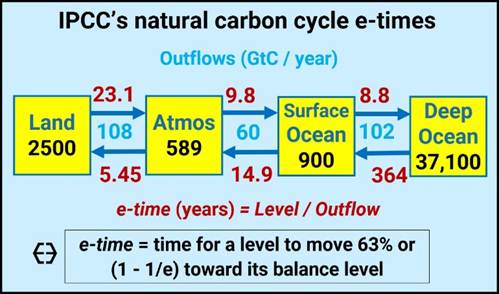
IPCC’s natural carbon cycle
Notice the flows (shown in blue) between adjoining boxes are equal. That means IPCC’s natural carbon cycle is at equilibrium. There is 589 GtC of carbon in the atmosphere, which is 280 ppm. The IPCC assumes that this was the state of the carbon cycle in 1750.
Berry found the six e-times (in red) for IPCC’s six outflows by using his equation (2). Then he applied these IPCC natural-carbon e-times to the IPCC’s human-carbon cycle based on the Climate Equivalence Principle.
The CEP requires that human and natural carbon have the same e-times.
Equation (2) says Outflow increases with Level when e-time is constant. Human carbon flows do not change the e-times because they are much smaller than natural carbon flows.
IPCC’s “true” human carbon cycle
Berry calculated IPCC’s “true” human carbon cycle by using the same physics as IPCC’s natural carbon cycle.
Berry’s calculations using IPCC’s own data prove that human CO2 cannot account for all of the CO2 increase. Rather, it accounts for only a very small part of the CO2 increase, which proves that natural CO2 causes most of it.
Berry (2021) shows that human CO2, using IPCC’s own data, increased CO2 levels by about 33 ppm as of 2020, while natural CO2 accounted for the remaining 107 ppm, bringing CO2 to 420 ppm.
Therefore, IPCC’s own data is not consistent with its claim that human CO2 causes all the CO2 increase above 280 ppm.
No one has found any error in Berry’s carbon cycle formulation or calculations.
Notice that Berry’s calculations use IPCC’s data for the natural carbon cycle. The IPCC says its carbon cycle data are accurate to about 20%. Berry’s result will change if IPCC changes its data.
Nevertheless, Berry’s calculations show that human CO2 emissions account for only a small share of the CO2 increase, according to the IPCC’s own data.
Therefore, IPCC’s own data prove Assumption (1) is false.
In Section 12, we use carbon-14 data to show that human CO2 adds less carbon to the atmosphere than IPCC’s natural carbon-cycle data indicate.
The key point is that the false claim – that human CO2 causes all the CO2 increase – is made by incompetent scientists who violate the CEP