
The lake and bucket carbon flow analogies
by Dr. Ed Berry
(editing in process)
The IPCC says human CO2 “accumulates” in the atmosphere. It doesn’t because the higher the CO2 level, the faster CO2 flows out of the air. This applies to human and natural CO2 separately and in total because their outflows are linear functions of their individual levels.
If the above statement is too complicated, read on for a simpler explanation of how CO2 flows through the atmosphere.
A lake analogy
CO2 flows through the atmosphere like water flows into a lake and then flows out over a dam.
Water does not “accumulate” in the lake because, as the lake level rises, the water outflow over the dam increases.
Similarly, CO2 does not “accumulate” in the atmosphere because, as the CO2 level rises, the CO2 outflow increases.
When the inflow is constant, the level will increase or decrease until outflow equals inflow. Then the level remains constant as long as the inflow remains constant.
That level is the “balance level,” which is set by the inflow, where outflow equals inflow.
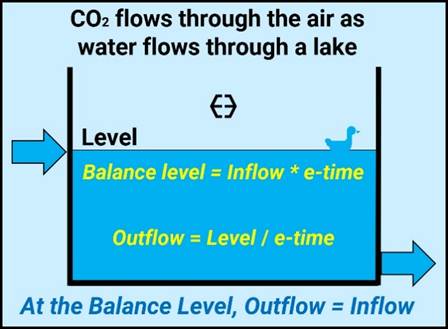
Human CO2 does not “add” carbon to the atmosphere. It adds to the CO2 inflow and, therefore, to the CO2 balance level, where continuing inflow does not change the level.
This is the same simple physics that explains how natural CO2 could have remained at 280 ppm, even with natural CO2 inflows far exceeding human CO2 inflows. The Climate Equivalence Principle says human CO2 flows follow the same physics as natural CO2 flows. Since natural CO2 flows might have a balance level of 280 ppm related to their inflows, human CO2 inflows also have a balance level that relates to its inflow.
(This explains what carbon capture really does. Carbon capture merely reduces the total CO2 inflow and slightly lowers the CO2 balance. The entire US national budget is not enough to measurably reduce total human CO2 emissions.)
A bucket analogy
Water flows into the top of the bucket that has a hole in the bottom.
As the water level rises, the outflow through the hole increases because the water pressure at the hole increases.
If the inflow is constant and the bucket is tall enough, the outflow will increase (or decrease) until it equals the inflow. Then the level will remain constant if the inflow remains constant.
CO2 does not accumulate in the atmosphere. It flows out as fast as it flows in when outflow equals inflow.
The key point is that carbon does not “accumulate” because inflows set the balance level so that outflows equal inflows, and the level stays constant.