
PREPRINT #3: Nature, not human emissions, caused most of the increase in CO2
by Edwin X Berry, Ph.D., Physics
May 1, 2020: I posted this updated version of my Preprint #2.
Copyright (c) 2020 by Edwin X Berry, Ph.D.
Abstract: The Intergovernmental Panel on Climate Change (IPCC) rests its case on its core assumption – that the natural carbon cycle stayed constant after 1750 and human carbon emissions caused all the increase in atmospheric carbon dioxide above 280 ppm. However, IPCC’s own data prove its core assumption is false. IPCC miscalculated its human carbon cycle. IPCC’s miscalculation led to false climate alarmism. To calculate the true human carbon cycle, we use IPCC’s data for its natural carbon cycle. This calculation shows human carbon emissions have added only 33 ppm to atmospheric CO2 as of 2020, which proves IPCC’s core assumption is false. Therefore, nature has added about 100 ppm to produce today’s level of atmospheric CO2. If ALL human carbon emissions were to stop in 2020, the human-caused increase in CO2 would fall to 10 ppm by 2100 and eventually decrease to 3 ppm. There are no long-term consequences of human carbon emissions. But atmospheric CO2 would never fall below 380 ppm if nature stayed constant. If nature continues to release carbon into the carbon cycle, atmospheric CO2 will continue to increase. These results are the logical conclusion of IPCC’s data for its natural carbon cycle.
Keywords: carbon dioxide, CO2, climate change, carbon cycle, global warming
1. Introduction
1.1 IPCC begins with an invalid assumption
The core assumption of the United Nations Intergovernmental Panel on Climate Change (IPCC) [1] is the natural carbon cycle stayed constant after 1750 and human carbon emissions caused all the increase in atmospheric carbon dioxide greater than 280 ppm.
IPCC has made the belief in its core assumption the basis of its scientific reports. IPCC offers 3 arguments to support its belief that its core assumption is true:
- The total of all human carbon emissions since 1750 is greater than atmospheric carbon after 2000. This is a faulty argument because it ignores the flow of human carbon from the atmosphere to land and oceans. It also ignores that natural carbon emission are some 20 times greater than human carbon emissions.
- Ice-core data show atmospheric CO2 remained at 280 ppm for a few thousand years. This is a faulty argument because it lacks a testable hypothesis on what might cause nature to release more carbon into the carbon cycle after 1750.
- There is no known source of new natural carbon that can explain the increase in atmospheric CO2. This is a faulty argument because IPCC cannot prove such a source does not exist.
Science demands that IPCC’s core assumption remain an assumption, rather than to be claimed a fact. This paper uses IPCC’s own data to test this IPCC assumption and proves this IPCC assumption is false.
Yet, IPCC claims fully on the basis that its core assumption is true:
“With a very high level of confidence, the increase in CO2 emissions from fossil fuel burning and those arising from land use change are the dominant cause of the observed increase in atmospheric CO2 concentration.”
“The removal of human-emitted CO2 from the atmosphere by natural processes will take a few hundred thousand years (high confidence).”
The United Nations World Meteorological Organization (WMO) Global Carbon Project, [2] echoes IPCC’s core assumption to incorrectly claim:
“With solid justification, one can describe the annual carbon budgets as products of high scientific quality with strong political relevance.”
This paper’s proof that IPCC’s core assumption is false begins with one simple, testable physical hypothesis that satisfies Occam’s razor. This hypothesis is accepted as true in many scientific fields. This hypothesis allows the construction of a carbon cycle model that replicates IPCC’s estimated data for the natural carbon cycle. The derivations and calculations described herein have been thoroughly peer reviewed and tested.
The overall theory is always open to challenge but, so far, no one has shown it to be incorrect. Therefore, this paper presents a challenge to IPCC’s core assumption that the IPCC cannot ignore.
1.2 Statistics show IPCC’s core assumption is invalid
IPCC believes its core assumption is true because
“the observed rate of CO2 increase closely parallels the accumulated emission trends from fossil fuel combustion and from land use changes.”
Munshi [3] shows the “detrended correlation of annual emissions with annual changes in atmospheric CO2” is zero. Therefore, statistics show human carbon dioxide is not the primary cause of the increase in CO2.
Munshi [4] shows IPCC reports use circular reasoning and confirmation bias to support its core assumption:
“Circular reasoning is a logical fallacy in which research design and methodology as well as the interpretation of the data subsume the finding. This fallacy can be found in published research and it is more common in research areas such as archaeology, finance, economics, and climate change where the data are mostly time series of historical field data with no possibility for experimental verification of causation.
“In biased research of this kind, researchers do not objectively seek the truth, whatever it may turn out to be, but rather seek to prove the truth of what they already know to be true or what needs to be true to support activism for a noble cause.
“Confirmation bias is thought to play a role in climate change particularly since climate science provides the rationale for environmental activism and the noble cause of saving humanity or perhaps the planet from climate cataclysm.”
1.3 Prior research
Authors who support IPCC’s core assumption include Maier-Remer et al. [5], Siegenthaler and Joos [6], Joos [7], Joos et al. [8], Jones et al. [9], Archer et al. [10], Cawley [11], Kohler et al. [12], and Gruber et al. [13].
Authors who do not support IPCC’s core assumption include Revelle and Suess [14], Kuo et al. [15], Starr [16], Segalstad [17], Jaworoski [18, 19], Beck [20], Rorsch, Courtney, and Thoenes [21], Courtney [22], MacRae [23], Quirk [24], Essenhigh [25], Glassman [26], Salby [27, 28], Humlum [29], Harde [30, 31], Berry [32-34].
The 2008 comprehensive study by Courtney [22] concluded,
“there is no evidence that the recent rise in atmospheric CO2 concentration has a mostly anthropogenic cause or a mostly natural cause.”
Berry [34] shows Cawley [11] made physics errors because of bad assumptions. Cawley’s errors derail the arguments of Kohler et al. [12] that attempted to invalidate Harde [30].
Segalstad [17], Jaworowski [18, 19], and Beck [20] present evidence that the natural CO2 level before 1750 was much higher than the 280-ppm assumed by IPCC. Nevertheless, this paper uses IPCC’s core assumption to test the consequences of this IPCC assumption.
This paper converts carbon units of GtC (Gigatons of Carbon) and PgC (Petagrams of Carbon) into CO2 units of ppm (parts per million by volume in dry air) using:
1 ppm = 2.12 GtC = 2.12 PgC
1.4 The Equivalence Principle
IPCC [1] incorrectly claims human carbon will remain in the atmosphere for thousands of years while natural carbon flows freely out of the atmosphere.
IPCC incorrectly claims the small amount of human carbon compared to natural carbon is enough to disrupt the balance of nature.
IPCC makes these invalid claims because it assumes nature treats human carbon differently than it treats natural carbon. These IPCC claims are impossible because nature cannot tell the difference between human and natural carbon because human and natural carbon atoms are identical.
Nature treats human carbon the same as it treats natural carbon.
This conclusion is an extension of the Equivalence Principle that Einstein used to derive his theory of relativity. Einstein reasoned as follows: since we cannot do an experiment that will distinguish between gravity and inertial forces, then gravity must be the same as an inertial force.
The Equivalence Principle applied to climate physics says the human carbon cycle must follow the same physics as the natural carbon cycle. The time constants for human carbon must be the same as the time constants for natural carbon.
1.5 The source of natural carbon cycle time constants
Courtney [22] (pp. 6-7) concluded in 2008 that the human carbon cycle could not be calculated because its time constants were unknown:
“… the relatively large increase of CO2concentration in the atmosphere in the twentieth century (some 30%) … requires a quantitative model of the carbon cycle, but … such a model cannot be constructed because the rate constants are not known for mechanisms operating in the carbon cycle.”
However, upon reviewing this paper’s Preprint, Courtney [35] wrote that this paper:
“… quantifies the anthropogenic and natural contributions to changes in atmospheric CO2 concentration without need for knowledge of rate constants for individual mechanisms. This is a breakthrough in understanding which [other authors] including myself all failed to make.”
2. IPCC natural and human carbon cycles
2.1 IPCC’s natural carbon cycle
There are four major carbon reservoirs: land, atmosphere, surface ocean, and deep ocean. The “level” of each reservoir is the mass of carbon in each reservoir.
IPCC [1] Figure 6.1 shows IPCC’s natural and human carbon cycles. Its legend says,
“Black numbers and arrows indicate reservoir mass and exchange fluxes estimated for the time prior to the Industrial Era, about 1750.”
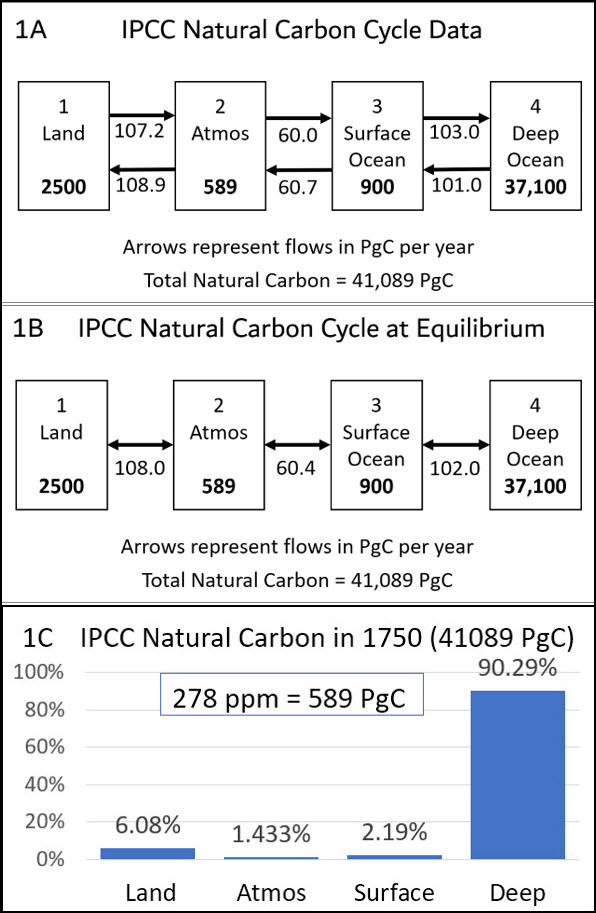
Figure 1A shows IPCC’s Figure 6.1 data for its natural carbon cycle levels and flows.
IPCC [1] says “typical uncertainties are more than 20%”. But its Figure 6.1 does not show any uncertainties. Therefore, we use the IPCC data as shown.
IPCC assumes natural carbon levels remained constant since 1750. That assumption requires an equilibrium scenario where the net flows between each reservoir are zero.
IPCC’s natural flows are close to net zero but not exactly so. Therefore, we define net zero flows that approximate the average of IPCC’s flows between the reservoirs. Exact averages are not necessary because IPCC’s flow data are not exact.
Figure 1B shows an equilibrium scenario with net zero flows that fit IPCC’s Figure 1A data.
Figure 1C shows the IPCC carbon level histogram for Figures 1A and 1B.
Figure 1C shows only 1.43 percent of natural carbon is in the atmosphere and 90 percent is in the deep ocean. This is a more precise form of the common observation that the oceans contain about 50 times as much carbon as the atmosphere.
2.2 IPCC’s human carbon cycle
We define human carbon as the carbon atoms inserted into the atmosphere by burning carbon fuels and producing cement. We ignore the carbon produced by human-caused changes in land use because that effect is not well quantified, and it is much smaller than the effect of burning carbon fuels and cement production.
IPCC [1] Figure 6.1 shows IPCC’s natural and human carbon cycles. Its legend says,
“Red arrows and numbers indicate annual ‘anthropogenic’ fluxes averaged over the 2000–2009 time period. These fluxes are a perturbation of the carbon cycle during Industrial Era post 1750.”
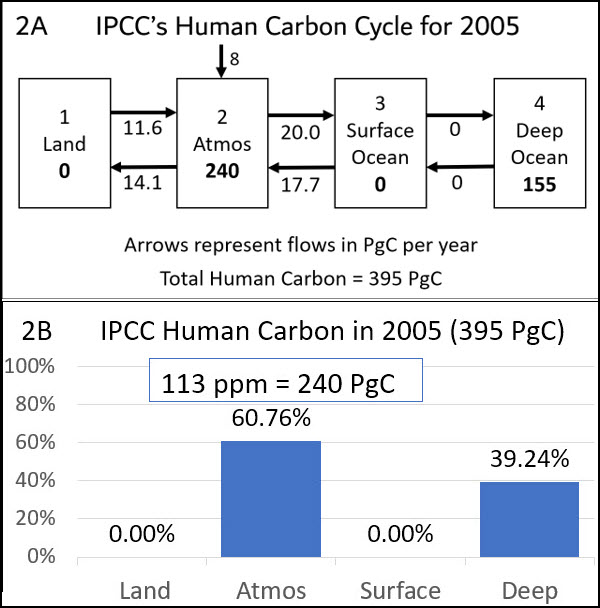
Figure 2A shows IPCC’s human carbon cycle for 2005 from its Figure 6.1 data. The human carbon inflow of 8 PgC per year (from fossil fuel burning and cement production) matches Boden et al. [36] calculated inflow for 2005 of 8.04 PgC. Figure 2B shows the percentage levels for Figure 2A.
Even though the human carbon cycle is not at equilibrium, the percentage levels for the human carbon cycle (Figure 2B) should resemble the percentage levels for IPCC’s natural carbon cycle (Figure 1C) because human carbon flows through the carbon cycle like natural carbon flows through the carbon cycle.
IPCC claims that 240 PgC (113 ppm) or about 61 percent of all human carbon emissions remains in the atmosphere as of 2005. This 61 percent happens to equal the amount IPCC needs to support its core assumption.
IPCC admits it does not show human carbon in the land or surface ocean. But that admission does not resolve the problems with IPCC’s human carbon cycle. IPCC shows no human carbon has flowed to land or surface ocean. And without carbon in the surface ocean, no carbon can flow to the deep ocean. IPCC’s human carbon cycle is a charade.
Clearly, IPCC did NOT calculate its human carbon cycle. IPCC simply inserted its core assumption – that human emissions caused all the increase above 280 ppm – into its claimed human carbon cycle. Yet, all IPCC’s claims of a climate emergency rest upon its invalid human carbon cycle.
Harde [37] observed that IPCC’s Figure 6.1 shows human emissions add 4.0 PgC per year to the atmosphere. That IPCC addition per year is 52 percent of IPCC’s 7.8 PgC per year total human inflow, which is less than IPCC’s 61 percent in Figure 2B.
We will use the Physics model to calculate a human carbon cycle that is consistent with IPCC’s natural carbon cycle.
3. The Physics Model
3.1 Physics Model description
There are four key carbon reservoirs: land, atmosphere, surface ocean, and deep ocean. The “level” of each reservoir is the mass of carbon in each reservoir. We apply the Physics model to each reservoir.
Figure 3A shows the Physics model for carbon in the atmosphere. The same model applies to carbon in any reservoir. The carbon in the atmosphere is in the form of CO2.
Figure 3B shows individual outflows where the arrows are all positive numbers. The origin of each outflow is defined as a “node.” There are six nodes.
Figure 3C shows the capacitor analogy diagram that has the same properties as the Physics model.
Now, we will derive the mathematical equations for Figures 3A, 3B, and 3C.

3.2 Physics Model derivation
This derivation follows Figure 3A.
The calculation of the carbon cycle requires a theoretical base. A system describes a subset of nature. A system includes levels and flows between levels. Levels set flows and flows set new levels.
Following [34], the Physics model derivation begins with the continuity equation (1) which says the rate of change of level is the difference between inflow and outflow:
| dL/dt = Inflow – Outflow | (1) |
where
- L = carbon level (in PgC)
- t = time (years)
- dL/dt = rate of change of L (PgC / year)
- Inflow = rate carbon moves into the system (PgC / year)
- Outflow = rate carbon moves out of the system (PgC / year)
The Physics model has only one hypothesis: outflow is proportional to level:
| Outflow = L / Te | (2) |
where Te is the “e-folding time” or simply “e-time.” E-time is the time for the level to move (1-1/e) of the distance from its present level to its balance level.
Substitute (2) into (1) to get,
| dL/dt = Inflow – L / Te | (3) |
When dL/dt is zero, the level will be at its balance level. Define the balance level, Lb, as
| Lb = Inflow * Te | (4) |
Substitute (4) for Inflow into (3) to get,
| dL/dt = – (L – Lb) / Te | (5) |
Equation (5) shows the level always moves toward its balance level. The variables L, Lb, and Te are functions of time.
In the special case when Lb and Te are constant, which means Inflow is constant, there is an analytic solution to (5). Rearrange (5) to get
| dL / (L – Lb) = – dt / Te | (6) |
Then integrate (6) from Lo to L on the left side, and from 0 to t on the right side to get
| Ln [(L – Lb) / (Lo – Lb)] = – t / Te | (7) |
where
- Lo = Level at time zero (t = 0)
- Lb = the balance level for a given inflow and Te
- Te = time for L to move (1 – 1/e) from L to Lb
- e = 2.7183
The original integration of (6) contains two absolute values, but they cancel each other because both L and Lo are always either above or below Lb.
Raise e to the power of each side of (7), to get the level as a function of time:
| L(t) = Lb + (Lo – Lb) exp(– t/Te) | (8) |
Equation (8) is the analytic solution of (5) when Lb and Te are constant.
All equations after (2) are deductions from hypothesis (2) and the continuity equation (1).
3.3 Physics Model properties
The Physics model allows external processes to change a reservoir’s level only by changing the reservoir’s inflow, outflow, or e-time. Therefore, by definition, the Physics model INCLUDES ALL EFFECTS OF EXTERNAL PROCESSES (chemical, biological, etc.) on the level of carbon in a reservoir.
The Physics model’s only hypothesis (2) is a linear function of level. This means the Physics model applies independently and in total to human and natural carbon. The balance levels of human carbon and natural carbon are independent.
The Physics model also applies independently and in total to all definitions of carbon or CO2. For example, it applies independently to human CO2, natural CO2, and their sums, and to 12CO2, 13CO2, and 14CO2, and their sums.
However, if outflow (2) were a “strictly increasing function” of level other than level to the power of one, then the Physics model would NOT apply independently and in total to human CO2and natural CO2.
Because of (2), it is not necessary (or desirable) to compute the carbon cycle for human and natural carbon simultaneously. It is better (and simpler) to compute their effects separately. Just ADD ANOTHER INSTANCE of the Physics model for each carbon definition. The separate results can be summed to produce the total result.
Read the following slowly.
Equation (4) shows how inflow sets a balance level. Equation (5) shows how the level moves toward the balance level with a speed determined by e-time. When the level equals the balance level, outflow will equal inflow. At the balance level, continuing constant inflow will maintain a constant level of carbon in the reservoir. Carbon will not accumulate in the reservoir.
If inflow decreases, the balance level decreases, and the level follows the balance level. The rate of change responds immediately to changes in inflow, but the level will lag the balance level.
3.4 Physics Carbon-Cycle Formulation
“The formulation of a problem is often more essential than its solution…” – Albert Einstein
This derivation follows Figure 3B.
There can be no solution for the carbon cycle until there has been a formulation of the problem. The following derives the Physics carbon cycle model.
Define the Levels:
- L1 = level of carbon in the land
- L2 = level of carbon in the atmosphere
- L3 = level of carbon in the surface ocean
- L4 = level of carbon in the deep ocean
Define the individual flows out of the six nodes:
- F12 = flow from land to atmosphere
- F21 = flow from atmosphere to land
- F23 = flow from atmosphere to surface ocean
- F32 = flow from surface ocean to atmosphere
- F34 = flow from surface ocean to deep ocean
- F43 = flow from deep ocean to surface ocean
Define other variables:
- t = time in years
- Hfa = Human-caused flow from fuels to atmosphere
- Hga = Human-caused flow from land to atmosphere
The term Hga is included for completeness but it is set to zero in all calculations in this paper. Hfa adds new carbon to the carbon cycle whereas Hga does not.
Using (2), the flows out of the six nodes are:
- F12 = L1 / T12
- F21 = L2 / T21
- F23 = L2 / T23
- F32 = L3 / T32
- F34 = L3 / T34
- F43 = L4 / T43 (9)
Physics Rate Equations
Using (9) and (1), the rate equations for each reservoir are:
| dL1/dt = F21 – F12 – Hga | ||
| dL2/dt = F12 – F21 + F32 – F23 + Hfa + Hga | ||
| dL3/dt = F23 – F32 + F43 – F34 | ||
| dL4/dt = F34 – F43 | (10) |
Equations (9) and (10) are used to calculate the natural and the human carbon cycles.
3.5 Capacitor Analogy for the Carbon-Cycle
This derivation follows Figure 3C.
Happer and Wijngaarden [38] proposed a capacitor analogy for Physics carbon cycle model. Four capacitors represent the four reservoirs. The charge on the capacitors represents the carbon levels in each reservoir. And three resistors represent the “resistance to flow” between the four reservoirs.
The ends of each resistor become “nodes.” Current is the analogy of flow.
Ohm’s law requires the net flow between nodes to be
Net_Fjk = (Vj – Vk) / Rjk (11)
Net_Fjk = Fjk – Fkj (12)
Therefore, the outflow from each node is
Fjk = Vj / Rjk (13)
where
Rjk = Rkj (14)
The charge on a capacitor is the analog of the carbon level, L, so
Vj = Lj / Cj (15)
Substituting (15) into (13), we get the flow out of each node:
Fjk = Lj / Rjk Cj (16)
Comparing (16) to (9) shows the capacitor analogy of Te is
Tjk = Rjk Cj (17)
Therefore, the nodal flows for the capacitor analogy are the same as the nodal flows for the Physics model (9) when (17) replaces the Tjk in (9).
At equilibrium, all Vj are equal. Therefore, (15) means
Lj / Cj = Lk / Ck (18)
In an electrical RC circuit, the time constant “tau” is
Tau (seconds) = C (Farads) * R (Ohms) (19)
The capacitor model uses the same equations and data as the Physics carbon cycle model. Therefore, their results will be identical.
4. Carbon Cycle Calculations
4.1 Derive e-times from IPCC’s data
We set the flows in (9) to equal IPCC’s equilibrium flows shown in Figure 1B:
- F12 = L1 / T12 = 108.0
- F21 = L2 / T21 = 108.0
- F23 = L2 / T23 = 60.4
- F32 = L3 / T32 = 60.4
- F34 = L3 / T34 = 102.0
- F43 = L4 / T43 = 102.0 (20)
We set the levels to equal IPCC’s equilibrium levels shown in Figure 1B:
- L1 = 2500
- L2 = 589
- L3 = 900
- L4 = 37,100 (21)
Then, we insert the level values in (21) into (20) and solve for the six equilibrium e-times for each of the six flow nodes in (20), and relate these e-times to the RC terms in (17):
- T12 = 2500 / 108 = 23.1481 years = R12 C1
- T21 = 589 / 108 = 5.4537 years = R12 C2
- T23 = 589 / 60.4 = 9.752 years = R23 C2
- T32 = 900 / 60.4 = 14.9007 years = R23 C3
- T34 = 900 / 102 = 8.8235 years = R34 C3
- T43 = 37100 / 102 = 363.7255 years = R34 C4 (22)
These e-times result from IPCC’s data for the natural carbon cycle. These same e-times must apply to the human carbon cycle to be consistent with IPCC’s natural carbon cycle.
If IPCC were to update its data for its natural carbon cycle, we would update the values in (20), (21), and (22).
4.2. Physics human carbon cycle
IPCC says human carbon is a “perturbation” on the natural carbon cycle. The implication is human carbon disrupts the “perfect” natural carbon cycle. The implication is incorrect.
Perturbation analysis as used in science has another meaning. It means to use the solution for one problem to solve a similar problem. The key is that the unsolved problem must have the same fundamental properties as the solved problem.
Boden et al. [36] show data for human carbon emissions data from 1750 to 2014. This paper extends [36] data with estimates of human emissions from 2015 through 2019.
The Physics model’s human carbon cycle calculation begins with the levels in all reservoirs at zero in 1750. The numerical calculations insert annual human carbon emissions into the atmosphere from 1750 through 2019. Each numerical time step allows carbon to flow from the atmosphere to land and surface ocean, and from surface ocean to deep ocean according to the e-times in IPCC’s natural carbon cycle.
The calculations insert the e-times of (22) into (9) to calculate the flows. Then they insert the flows into (10) to calculate the rate of change of the levels. Then they update the levels and repeat for each time step.
Happer and Wijngaarden [38] used an independent “relaxation method” to check the numerical results described in this paper and found identical results accurate to 2 decimal places.
Figure 4 shows the results of the Physics model for 2005, 2020, and 2100. The scenario for 2100 assumes that all human emissions stop in 2020. These results include the recycling of human carbon from the other reservoirs back into the atmosphere.
Figure 4A for the human carbon cycle is consistent with IPCC’s natural cycle in Figure 1C. It is just not at equilibrium. Figure 4A shows what IPCC’s Figure 2B should look like.
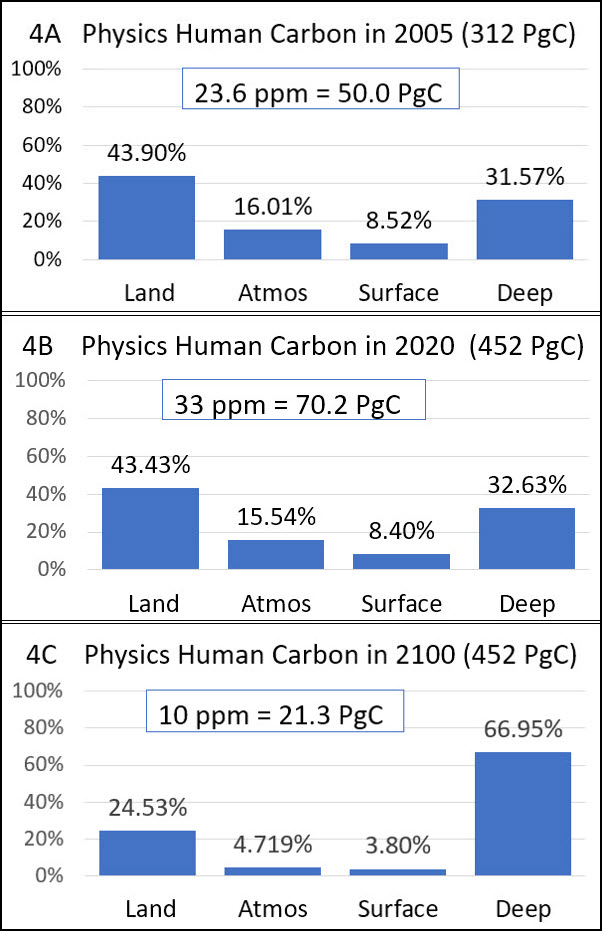
Figure 4B for 2020 shows only 15.54 percent of the human carbon emissions since 1750 remain in the atmosphere. Human carbon adds only 33 ppm to the 2020 level of atmospheric CO2 because most human carbon has flowed to other reservoirs. This result shows that nature has added 100 ppm to atmospheric CO2 as of 2020, which contradicts IPCC’s core assumption.
Figure 4C shows the percentage distribution of human carbon in 2100 assuming all human carbon emissions stopped in 2020. Less than 5 percent of all human carbon remains in the atmosphere. This begins to compare with IPCC natural equilibrium percentages shown in Figure 1C.
Harde [31] calculates the human carbon cycle using a different method than shown here and finds similar results.
IPCC’ data uncertainties do not change the conclusion that IPCC’s core assumption is wrong. Any scenario within IPCC’s data uncertainty range will show a human carbon cycle that differs dramatically from IPCC’s core assumption.
4.3 Approximate new natural carbon
Figure 4B shows human carbon emissions have added 451.55 PgC to the human carbon cycle while adding 33 ppm to the atmosphere. (The decimal places show numerical accuracy, not IPCC’s data accuracy.)
For natural carbon emissions to have caused a rise of 100 ppm during the same period, natural carbon emissions would have added about 100/33 or 3 times as much carbon to the carbon cycle as human emissions added.
The multiplier of 3 is only approximate because natural carbon additions may first appear in the land or oceans rather than in the atmosphere and later add to the atmosphere.
Nevertheless, to calculate an approximate value, we assume nature has added 3 times 451.55 PgC, or 1355 PgC, to the natural carbon cycle in order to add 100 ppm to the atmosphere as of 2020. The addition adds 3.3 percent to the 41089 PgC in IPCC’s natural carbon cycle for 1750.
It is outside the scope of this paper to speculate about what may have caused the addition of 3.3 percent to the carbon in the natural carbon cycle since 1750. It will suffice to note the following.
Kuo et al. [15] shows changes in atmospheric CO2 lag temperature changes by five months. MacRae [23] and Salby [27, 28] shows the rate of change of CO2 follows increases in surface temperature. Harde [30, 31] plots how CO2 level increases with surface temperature.
4.4 The long-term effect of human carbon emissions
Harde [27, 28] and Berry [34] estimated the addition of human carbon has added 17 ppm and 18 ppm to the atmosphere, respectively. These values were based upon IPCC’s ratio of natural to human inflows close to equilibrium.
Figure 4B shows human carbon has added 33 ppm as of 2020 but this is not an equilibrium scenario. Figure 4B represents a dynamic scenario where human carbon is being added to the atmosphere and levels are not at their equilibrium levels.
Figure 4C shows the scenario where human carbon has had time to approach its equilibrium levels. This scenario shows only 4.72 percent, or 10 ppm, of all human carbon will remain in atmosphere after 80 years. The values estimated by Harde [30, 31] and Berry [34] apply to a consistent rather than increasing human carbon inflow.
The long-term equilibrium level of all human carbon emitted as of 2020 will equal the natural carbon percentages shown in Figure 1C. In this case, only 1.43 percent, or 6.46 PgC or 3.0 ppm, of human carbon would remain in the atmosphere.
These equilibrium numbers show IPCC’s claims that human carbon emissions do permanent damage are based upon its invalid core assumption.
5. Discussion
5.1 Carbon cycle time series
Etheridge et al. [39] provide CO2 levels derived from Antarctic ice and firn for the years 1832 to 1978. Keeling et al. [40] show in situ data for CO2 levels from 1959 to 2019.
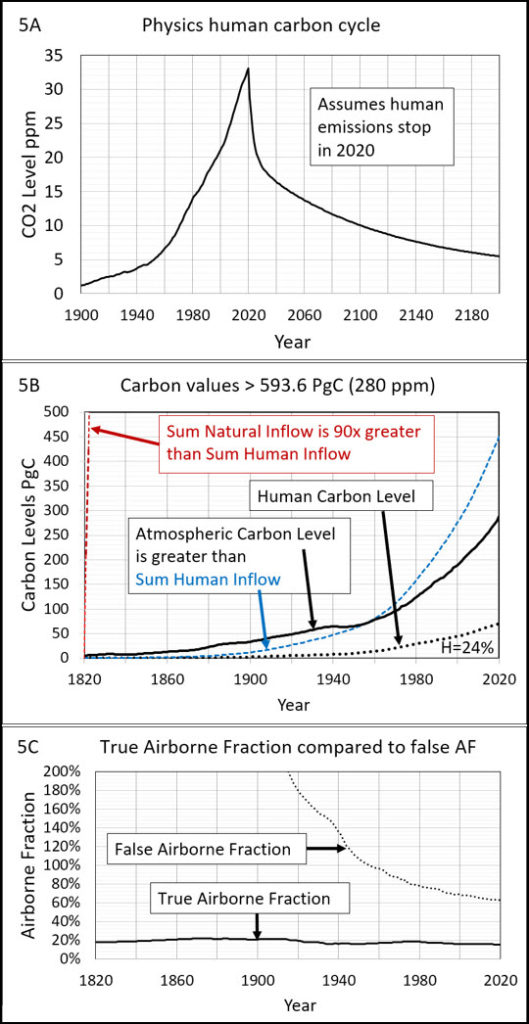
Figure 5A shows the Physics model human carbon dioxide level from 1900 to 2100 assuming all human carbon emissions stop in 2020. Human carbon increases CO2 up to 33 ppm at the end of 2019. The rapid drop in this human effect beginning in 2020 shows how the human effect is temporary. It falls by half in ten years and is only 5 ppm in 2100.
Figure 5B plots the human carbon cycle level as Figure 5A but from 1820 to 2020. This plot is for atmospheric carbon levels above 593.6 PgC (280 ppm).
Total atmospheric carbon is from [39] and [40] data. The sum of all human carbon emissions since 1750 is from [36] data. Notice the sum of all human carbon emissions before 1955 are less than total atmospheric carbon. This means human carbon emissions cannot have caused the increase in CO2 before that year.
These data contradict IPCC’s core assumption that requires total human carbon emissions to be GREATER THAN the measured atmospheric carbon above 280 ppm. Clearly, natural carbon had to cause the rise in atmospheric CO2 before 1955. Therefore, IPCC’s core assumption is invalid.
That takes care of before 1955. After 1955 the sum of human carbon is greater than total atmospheric carbon. However, this is to be expected because the sum of human carbon continues to increase because it is a sum. This sum is artificial. It is not a measure of the effect of human carbon emissions because human carbon in the atmosphere flows to land and oceans every year.
Figure 5B shows the human carbon level calculated by the Physics carbon cycle model. This human carbon level is the amount of human carbon that remains in the atmosphere at the end of each year. This amount is much less than the atmospheric carbon level.
At the end of 2019, the human carbon level is only 24 percent of atmospheric carbon. Therefore, nature has added the other 76 percent to atmospheric carbon. Therefore, IPCC’s core assumption is invalid.
5.2 Airborne Fraction uses Physics model hypothesis
Jones et al. [9] define the airborne fraction (AF) as,
“The fraction of anthropogenic carbon emissions that remain in the atmosphere after natural processes have absorbed some of them.”
But [34] ASSUME human emissions caused all CO2 above 280 ppm (C280), or:
C280 = the level of atmospheric CO2 – 280 ppm (23)
So, the [34] definition of AF is:
AF = C280 / L (24)
where
L = the sum of all human CO2 emissions since 1750
However, the true airborne fraction (TAF) is:
TAF = La / L (25)
Where
La = the true value of human carbon that remains in the atmosphere.
The [9] rate equation for AF, when converted to the terms used in this paper, is
| dL/dt = Inflow – ((L + 280) – 280)/ Te | ||
| dL/dt = Inflow – L / Te | (26) |
Equation (26) is the Physics model equation (3). So, the [34] AF agrees with the Physics model assumption (2):
| Outflow = L / Te | (2) |
Therefore, [9] supports the Physics model.
Figure 5C plots the True Airborne Fraction (TAF) and the IPCC Airborne Fraction (AF).
The realistic TAF is always about 20 percent. The unrealistic AF is off the chart before 1915 and progresses downward to 60 percent in 2020.
AF is built upon IPCC’s invalid core assumption. Therefore, AF has no physical meaning.
5.3 Bern versus Physics model pulse decay
In 2002, Joos [7] showed the integral equation for the Bern model (Appendix B). The Bern model assumes human carbon enters the atmosphere in sequential annual pulses and the carbon in each pulse flows out of the atmosphere independently from all other annual pulses. The Bern model integrates these annual inflows and their expected outflows over time.
If we set t’ = 0 in the Bern integral equation, the integral reduces to an equation for a one-year carbon pulse (B1). If we set t equal to infinity in (B1), it shows that 15.2 percent of every pulse will remain in the atmosphere forever. Of course, that is unrealistic.
Joos [7] curve-fit the Bern model to the airborne fraction (AF) and thereby derived the Bern TAR standard values. However, AF is meaningless because it is based on IPCC’s invalid core assumption. Therefore, the Bern model is also based on the invalid IPCC core assumption and is, therefore, meaningless.
In addition, the Bern model is not a “model.” It does not calculate the rate of change of level. It is not a function of its level, L, at time t. It is only a function of its starting level, Lo, and time, t. The starting level is history. No model of nature is a function of its history because nature does not know its history. Nature only knows its present and acts accordingly.
Figure 6A compares the Physics model and Bern model predictions for a pulse inflow.
The Physics model predicts a pulse will decay to 15 percent in 10 years and 5 percent in 100 years. By contrast, the Bern model predicts a pulse will decay to 55 percent in 10 years and to 30 percent in 100 years and will never get below 15 percent.
Figure 6B shows how a carbon pulse in the atmosphere moves to the other reservoirs according to the Physics model. The atmosphere level, La, in Figures 6A and 6B is identical.
It takes only 10 years for the carbon in the atmosphere to reach 15 percent of its initial value. At the same time, 55 percent of human carbon is in the land. After 10 years the human carbon in the land makes its way to the deep ocean.
After 100 years, only 5.1 percent of human carbon remains in the atmosphere, 28 percent is in the land, and 64 percent is in the deep ocean.
The Bern model cannot predict where the carbon goes because it is neither a model nor a carbon cycle model.

5.4 History of human carbon cycle research
In 1987, Maier-Reimer and Hasselmann [5] used an ocean circulation model connected to a one-layer atmosphere to reproduce the main features of the CO2 distribution in the surface ocean. They approximated the flow of CO2 from the atmosphere into the ocean by a sum of four exponentials with different amplitudes and time constants.
In 1992, Siegenthaler and Joos [6] created the original Bern model. They used 14C data to trace the flow of 12CO2 from the atmosphere to the upper ocean and to the deep and interior oceans. They used the IPCC core assumption – that human CO2 emissions caused all the increase in atmospheric CO2 above 280 ppm. They justified their assumption with this statement,
“The ice core CO2 data from the South Pole indicate a rather stable atmospheric CO2 level in the millennium preceding industrialization.”
They processed their data based upon the IPC core assumption. All their conclusions derive from their incorrect assumption.
Archer et al. [10] tested all IPCC carbon-cycle models and found they all
“agree that 25-35% of the CO2 remains in the atmosphere after equilibrium with the ocean (2-20 centuries).”
However, all models that [10] tested used the IPCC core assumption. All the models incorrectly assume natural carbon stays balanced while human carbon disrupts the natural balance. Therefore, all tested models assumed human and natural carbon follow different rules, which violates the Equivalence Principle.
What [10] calls a “long tail” it not a result of changing e-times. The nodal e-times remain constant but their weight on the flow of carbon from the atmosphere changes as their levels change. This gives the appearance of changing e-times.
It is a result of the increase in the human carbon dioxide balance level caused by the new carbon added to the human carbon cycle.
Joos et al. [8] compared the response of such atmosphere-ocean models to a pulse emission of human CO2. All [8] models use the IPCC core assumption and falsely predict a “substantial fraction” of pulse would remain in the atmosphere and ocean for millennia.
Gruber et al. [13] also use the IPCC core assumption. They [13] claim to prove the increase in ocean carbon is caused by human carbon. However, that conclusion is not the result of physics. It is a result of using the IPCC core assumption.
They [9] incorrectly assume the IPCC claim that human carbon caused all the increase. They do not even discuss the possibility that natural carbon may have caused their measured increase.
All these IPCC-based models use IPCC’s core assumption. As such, these IPCC-based models do not represent reality.
Berry [34] shows how the Physics Model equations (5) and (8) accurately replicate the D14C data from 1970 to 2014 with e-time set to 16.5 years, balance level set to zero, and starting level set to the D14C level in 1970.
Conclusions
IPCC [1] has presented perhaps the best available estimated data for the natural carbon cycle. Yet, IPCC’s human carbon cycle conflicts with IPCC’s natural carbon cycle. IPCC’s human carbon cycle is merely a replication of IPCC’s core assumption rather than a result of a carbon cycle calculation.
The Physics model uses IPCC’s data for its natural carbon cycle. Then it calculates the resulting true human carbon cycle that is compatible with IPCC’s natural carbon cycle.
This true human carbon cycle shows human carbon emissions from fossil fuels and cement production, from 1750 to 2020, have added about 33 ppm to atmospheric CO2. Therefore, nature has added about 100 ppm since 1750 to produce today level of atmospheric CO2. This shows how IPCC’s own data prove IPCC’s core assumption in false.
If all human carbon emissions were to stop in 2020, only 10 ppm of the human-caused increase in CO2 would remain by 2010. It would gradually decrease to 3 ppm. This shows there are no long-term consequences of human carbon emissions.
Meanwhile, if nature stayed constant, CO2 would never fall below 380 ppm. But if nature continues to add carbon to the carbon cycle, then there would be no decrease in CO2. Reducing human carbon emissions cannot overcome the dominance of nature.
References
- IPCC. 2013. Carbon and other biogeochemical cycles. Fig. 6.1, p 471. CrossRef
- Candela, J., D. Carlson. 2017. The annual global carbon budget. World Meteorological Organization. CrossRef
- Munshi, J. 2017. Responsiveness of atmospheric co2 to fossil fuel emissions: updated. CrossRef
- Munshi, J. 2018. Circular reasoning in climate change research. CrossRef
- Maier-Reimer, E. and Hasselmann, K.: Transport and storage of CO2 in the ocean – an inorganic ocean-circulation carbon cycle model, Climate Dynamics 2(2):63–90; 1987. DOI: 10.1007/BF01054491 CrossRef
- Siegenthaler, U. and Joos, F.: Use of a simple model for studying oceanic tracer distributions and the global carbon cycle. Tellus, 44B, 186-207; 1992. CrossRef
- Joos, F. 2002. Parameters for tuning a simple carbon cycle model.CrossRef
- Joos, F., R. Roth, Fuglestvedt, J. S., Peters, G. P., Enting, I. G., von Bloh, et al.: Carbon dioxide and climate impulse response functions for the computation of greenhouse gas metrics: a multi-model analysis. Atmospheric Chemistry and Physics 13(5), doi: 10.5194/acpd-12-19799-2012. Atmos. Chem. Phys. 13, 2793-2825; 2013. CrossRef CrossRef
- Jones, C., P. Cox, C. Huntingford. 2013? The atmospheric CO2 airborne fraction and carbon cycle feedbacks. CrossRef
- Archer, D., M. Eby, V. Brovkin, A. Ridgwell, L. Cao, U. Mikolajewicz, et al. 2009. Atmospheric Lifetime of Fossil Fuel Carbon Dioxide. Annu. Rev. Earth Planet. Sci., 37, pp. 117–134. CrossRef, CrossRef2
- Cawley, G.C. 2011. On the Atmospheric residence time of anthropogenically sourced CO2. Energy Fuels 25, pp. 5503–5513. CrossRef
- Kohler, P., J. Hauck, C. Volker, D.A. Wolf-Gladrow, M. Butzin, J.B. Halpern, et al. 2017. Comment on ‘Scrutinizing the carbon cycle and CO2 residence time in the atmosphere’ by H. Harde. Global and Planetary Change. CrossRef
- Gruber, N., D. Clement, B. Carter, R. Feely, S. van Heuven, M. Hoppema, M. Ishii, R. Key, A. Kozyr, S. Lauvset, C. Lo Monaco, J. Mathis, A. Murata, A. Olsen, F. Perez, C. Sabine, T. Tanhua, R. Wanninkhof. 2019. The oceanic sink for anthropogenic CO2 from 1994 to 2007. Science, 15. March 2019, (363) pg. 1193. CrossRef
- Revelle, R., H. Suess. 1957. CO2 exchange between atmosphere and ocean and the question of an increase of atmospheric CO2 during past decades. Tellus. 9: 18-27; 1957. CrossRef
- Kuo, C., C. Lindberg, D. Thomson. 1990. Coherence established between atmospheric carbon dioxide and global temperature. Nature 343, 709–714 (1990). CrossRef
- Starr, C. 1992. Atmospheric CO2 residence time and the carbon cycle. Science Direct, 18, 12, pp. 1297-1310; 1992. CrossRef
- Segalstad, T. V. 1998. Carbon cycle modelling and the residence time of natural and anthropogenic atmospheric CO2: on the construction of the Greenhouse Effect Global Warming dogma. In: Bate, R. (Ed.): Global warming: the continuing debate. ESEF, Cambridge, U.K. (ISBN 0952773422): 184-219; 1998. CrossRef, CrossRef2
- Jaworowski, Z. 2003. Climate Change: Incorrect information on pre-industrial CO2. Statement written for the Hearing before the US Senate Committee on Commerce, Science, and Transportation. CrossRef
- Jaworowski, Z. 2007. CO2: The greatest scientific scandal of our time. 21st CENTURY Science & Technology. CrossRef
- Beck, E. 2007. 180 Years of Atmospheric CO2 Gas Analysis by Chemical Methods. Energy & Environment. Vol 18, No. 2. CrossRef
- Rorsch, A., R.S. Courtney, D. Thoenes. 2005. The Interaction of Climate Change and the CO2 Cycle. Energy & Environment, Volume 16, No 2. CrossRef
- Courtney, R.S. 2008. Limits to existing quantitative understanding of past, present and future changes to atmospheric CO2 concentration. International Conference on Climate Change, New York. CrossRef
- MacRae, A. 2008. Carbon dioxide is not the primary cause of global warming, the future cannot cause the past. CrossRef CrossRef
- Quirk, T. 2009. Sources and sinks of CO2. Energy & Environment. Volume: 20 Issue: 1, pp. 105-121. CrossRef
- Essenhigh,R.E. 2009. Potential dependence of global warming on the residence time (RT) in the atmosphere of anthropogenically sourced CO2. Energy Fuel 23, pp. 2773-2784. CrossRef
- Glassman, J.A. 2010. On why CO2 is known not to have accumulated in the atmosphere and what is happening with CO2 in the modern era. Rocket Scientist Journal. CrossRef
- Salby, M. L. 2012. Physics of the Atmosphere and Climate. Cambridge University Press. (ISBN: 978-0-521-76718-7) CrossRef
- Salby, M. L. 2018. What is really behind the increase in atmospheric CO2? Video Presentation, October 10. Helmut-Schmidt-University Hamburg, Germany. CrossRef
- Humlum, O., K. Stordahl, J.E. Solheim. 2013. The phase relation between atmospheric CO2 and global temperatures. Global and Planetary Change, 100, pp 51-69. CrossRef
- Harde, H. 2017: Scrutinizing the carbon cycle and CO2 residence time in the atmosphere. Global and Planetary Change. 152, 19-26. CrossRef
- Harde, H. 2019. What Humans Contribute to Atmospheric CO2: Comparison of Carbon Cycle Models with Observations. International Journal of Earth Sciences Vol. 8, No. 3, pp. 139-159. CrossRef
- Berry, E. X. 2018. A fatal flaw in global warming science. Basic Science of a Changing Climate. Porto University, Portugal. Sep 7. CrossRef
- Berry, E. X. 2019a. Contradictions to IPCC’s climate change theory. Annual meeting of the American Meteorological Society, Phoenix. CrossRef
- Berry, E. X. 2019b. Human CO2 emissions have little effect on atmospheric CO2. International Journal of Atmospheric and Oceanic Sciences. Volume 3, Issue 1, June 2019, pp 13-26. CrossRef
- Courtney, R.S., 2019. Public comment on global-warming-realists@googlegroups.com, Nov 21, 2019.
- Boden, T., B. Andres. 2017. Global CO2 emissions from fossil-fuel burning, cement manufacture, and gas flaring: 1751-2014. CrossRef
- Harde, H. 2020. Personal communication.
- Happer, W. and W.A. van Wijngaarden, 2020. Physics Rate Equations.
- Etheridge, D.M., L.P. Steele, R.L. Langenfelds, R.J. Francey, J.-M. Barnola, and V.I. Morgan. 1996. Natural and anthropogenic changes in atmospheric CO2 over the last 1000 years from air in Antarctic ice and firn. Journal of Geophysical Research 101:4115-4128. Law Dome Atmospheric CO2 Data, IGBP PAGES/World Data Center for Paleoclimatology Data Contribution Series #2001-083. NOAA/NGDC Paleoclimatology Program, Boulder CO, USA. CrossRef
- Keeling, C. D., S. C. Piper, R. B. Bacastow, M. Wahlen, T. P. Whorf, M. Heimann, and H. A. Meijer. 2001. Exchanges of atmospheric CO2 and 13CO2 with the terrestrial biosphere and oceans from 1978 to 2000. I. Global aspects, SIO Reference Series, No. 01-06, Scripps Institution of Oceanography, San Diego, 88 pages, 2001. CrossRef
Acknowledgments
The author thanks those who reviewed the Preprint of this paper: William Happer for his validation of the accuracy of the numerical calculations and his suggestion of the capacitor analogy; Hermann Harde for his excellent review and suggestions; Richard Courtney for his insight into the historical context; Chuck Wiese, Gordon Fulks, and Nils-Axel Morner for their reviews of the physics; Larry Lazarides, John Knipe, Ron Pritchett, Alan Falk, Leif Asbrink, Mark Harvey, Case Smit, Stephen Anderson, and Chic Bowdrie for their reviews and suggestions of edits to the early version of this paper.
Appendix B. IPCC Bern model
In 2002, Joos [7] showed the Bern model integral equation:

where
- fr = concentration
- CCO2 = constant (approximately 0.47 ppmv/GtC, but use this parameter to fine tune your results)
- ECO2 = emissions of CO2
- tCO2,S = atmospheric exponential decay time of the sth fraction
- of the additional concentration
- fCO2,0 = first fraction
- fCO2,S = respective fractions
The Bern model assumes human carbon enters the atmosphere in sequential annual pulses and the carbon in each pulse flows out of the atmosphere independently from all other annual pulses.
The Bern model integrates these annual inflows and their expected outflows over time.
To deconstruct the integral version of the Bern model, let inflow occur only in the year when t’ equals zero. Then the integral disappears, and the Bern model becomes a level equation that depends upon the starting level, Lo:
L(t) = Lo [ A0 + A1 exp(– t/T1) + A2 exp(– t/T2) + A3 exp(– t/T3)] (B1)
Where
- t = time in years
- Lo = level of atmospheric CO2 in year t = 0
- L(t) = level of atmospheric CO2 in year t
Joos [7] derived the Bern TAR standard values by curve-fitting the Bern model to the airborne fraction (AF). These standard values are,
- A0 = 0.152
- A1 = 0.253
- A2 = 0.279
- A3 = 0.316
- T1 = 171 years
- T2 = 18.0 years
- T3 = 2.57 years
The A-values weight the four terms on the right-hand side of (2), so,
A0 + A1 + A2+ A3 = 1.000
In (B1), set t equal to infinity to get,
L = A0 Lo = 0.152 Lo (B2)
Equation (B2) predicts a one-year inflow that sets Lo to, for example, 100 ppm, followed by zero inflow, will cause a permanent level of 15.2 ppm.
The Bern TAR standard values derive from a curve fit to AF, which based on the invalid core assumption that human carbon causes all the increase in atmospheric CO2.