
by Dr. Ed Berry
The easy way to calculate the effect of human CO2 emissions
Berry (2019) introduced the Physics model. While the Physics model is simple, it is subtle. It follows the methods of theoretical physics. It applies to all definitions of CO2 independently and in total.
The Physics model applies to CO2 subdivisions. For example, it applies to natural CO2 and to human CO2 independently and to their total. It also applies to 14CO2 (the 14C isotope version of CO2) and 12CO2 (the 12C isotope version of CO2) and to their total. If we use this property of the Physics model, we can save much time.
The discussion below is a preview of my next professional paper. I have added this preview so readers of these comments and replies will have some basic preparation on this subject. Otherwise, the comments and replies below may misdirect them into some confusion.
The comments use the terms “source” and “influence” to distinguish the direct effects of human CO2 from its indirect effects such as increasing natural CO2 inflow. While these definitions help communicate the concerns of the comments, there is a much more professional way to do physics.
First, look at the IPCC AR5 Fig. 6.1, shown below.
The following figure uses approximate data from IPCC Fig. 6.1. The approximate Te (e-times) are added using the IPCC level and outflow numbers. To understand e-times, you will need to read section 3 of my paper that is copied below.
However, you don’t need to understand e-time to understand this summary of my next paper. If you don’t follow the explanation below, you may wish to invite me to speak to your group. It would be much easier for me to explain this in person.
Here is a summary of the key points of AR5 Fig. 6.1 for the year 1750. Only the data in the upper-right, 870 PgC (410 ppm), and the 3000 PgC for land, are for 2018. Levels are in PgC. Flows are in PgC per year.
Confusing? Take this one step at a time.
The levels represent the equilibrium levels in 1750 according to the IPCC. Numbers are approximate. No one can measure these numbers exactly.
The flows represent how fast carbon moves between the reservoirs. Levels and flows let us approximate the e-times. E-times represent how long the carbon stays in a reservoir before it moves to another reservoir.
We could sit here for the next week and create a mathematical model to represent the figure. Then we could compute the effect of human CO2 on the level of atmospheric CO2.
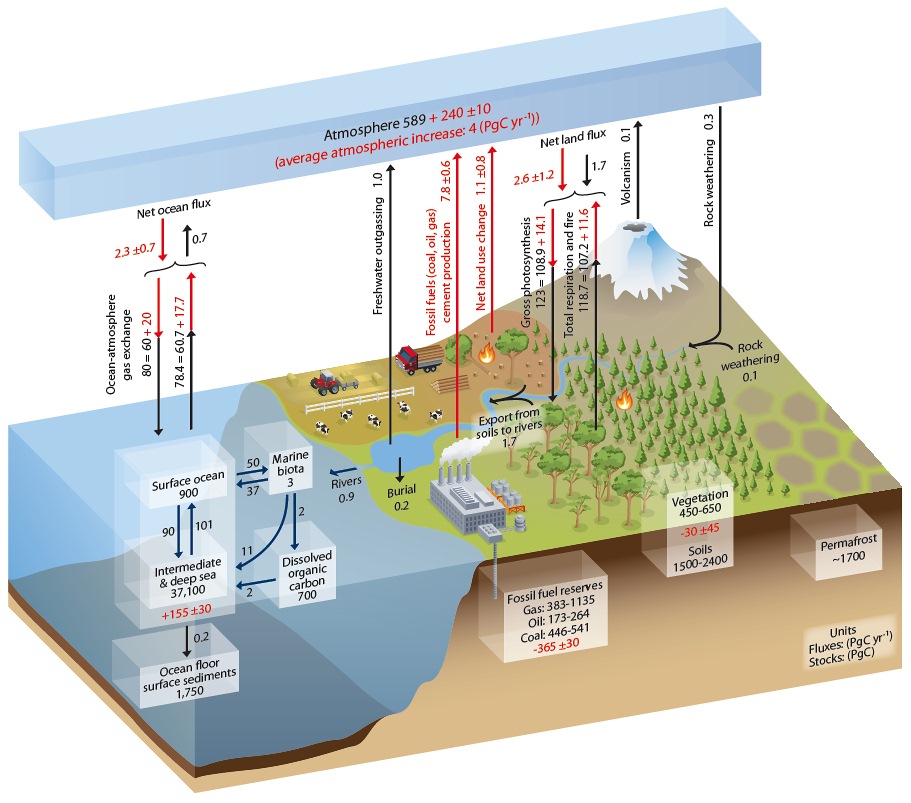
Figure 6.1 Simplified schematic of the global carbon cycle. (This is the IPCC figure legend.)
Numbers represent reservoir mass, also called ‘carbon stocks’ in PgC (1 PgC = 1015 gC) and annual carbon exchange fluxes (in PgC yr–1).
Black numbers and arrows indicate reservoir mass and exchange fluxes estimated for the time prior to the Industrial Era, about 1750 (see Section 6.1.1.1 for references). Fossil fuel reserves are from GEA (2006) and are consistent with numbers used by IPCC WGIII for future scenarios. The sediment storage is a sum of 150 PgC of the organic carbon in the mixed layer (Emerson and Hedges, 1988) and 1600 PgC of the deep-sea CaCO3 sediments available to neutralize fossil fuel CO2 (Archer et al., 1998).
Red arrows and numbers indicate annual ‘anthropogenic’ fluxes averaged over the 2000–2009 time period. These fluxes are a perturbation of the carbon cycle during Industrial Era post 1750. These fluxes (red arrows) are: Fossil fuel and cement emissions of CO2 (Section 6.3.1), Net land use change (Section 6.3.2), and the Average atmospheric increase of CO2 in the atmosphere, also called ‘CO2 growth rate’ (Section 6.3).
The uptake of anthropogenic CO2 by the ocean and by terrestrial ecosystems, often called ‘carbon sinks’ are the red arrows part of Net land flux and Net ocean flux.
Red numbers in the reservoirs denote cumulative changes of anthropogenic carbon over the Industrial Period 1750–2011 (column 2 in Table 6.1). By convention, a positive cumulative change means that a reservoir has gained carbon since 1750. The cumulative change of anthropogenic carbon in the terrestrial reservoir is the sum of carbon cumulatively lost through land use change and carbon accumulated since 1750 in other ecosystems (Table 6.1).
Note that the mass balance of the two ocean carbon stocks Surface ocean and Intermediate and deep ocean includes a yearly accumulation of anthropogenic carbon (not shown).
Uncertainties are reported as 90% confidence intervals.
Emission estimates and land and ocean sinks (in red) are from Table 6.1 in Section 6.3.
The change of gross terrestrial fluxes (red arrows of Gross photosynthesis and Total respiration and fires) has been estimated from CMIP5 model results (Section 6.4). The change in air–sea exchange fluxes (red arrows of ocean atmosphere gas exchange) have been estimated from the difference in atmospheric partial pressure of CO2 since 1750 (Sarmiento and Gruber, 2006).
Individual gross fluxes and their changes since the beginning of the Industrial Era have typical uncertainties of more than 20%, while their differences (Net land flux and Net ocean flux in the figure) are determined from independent measurements with a much higher accuracy (see Section 6.3).
Therefore, to achieve an overall balance, the values of the more uncertain gross fluxes have been adjusted so that their difference matches the Net land flux and Net ocean flux estimates.
Fluxes from volcanic eruptions, rock weathering (silicates and carbonates weathering reactions resulting into a small uptake of atmospheric CO2), export of carbon from soils to rivers, burial of carbon in freshwater lakes and reservoirs and transport of carbon by rivers to the ocean are all assumed to be pre-industrial fluxes, that is, unchanged during 1750–2011.
Some recent studies (Section 6.3) indicate that this assumption is likely not verified, but global estimates of the Industrial Era perturbation of all these fluxes was not available from peer-reviewed literature.
The atmospheric inventories have been calculated using a conversion factor of 2.12 PgC per ppm (Prather et al., 2012).